In the Star Trek universe, the audience occasionally gets
a glimpse inside schools on the planet Vulcan. Young children
stand alone in “capsules” surrounded by 360-degree digital
screens. Adults walk around but do not talk to the students.
Instead, each child interacts only with a sophisticated artificial
intelligence (AI). Although this is not the reality in today’s
classrooms on Earth, there are people for whom a vision of
personalized learning conducted by artificial intelligence has
considerable appeal.
Individualized learning has its place. But decades of
educational research also demonstrate that learning is
essentially a social endeavor. Classrooms that privilege
personalized AI chatbots overlook that fact.
Generative AI is quickly coming to classrooms. If decades
ago educators worldwide promoted the benefits of “One
Laptop per Child”, today we may be approaching the model
“one chatbot per child.” What does educational research tell
us about what this model could mean for children’s learning
and well-being?
During much of the 20th century, learning was understood
as mainly as a matter of individual cognition. A misconception,
if compared to today’s comprehension of what learning
involves. Scientists now understand that apparently individual
processes – such as building new knowledge – are actually
social interactions with the world around us. In classrooms,
this suggests that opportunities for daily personal interaction
can strongly support brain health and academic learning.
Therefore, it is important to understand generative AI’s
real-life impact on students.
For example: How does it feel to learn from a chatbot, day
after day? How will long-term use of AI affect children’s mental
health? How does AI use affect children’s relationships with
each other and with their teachers? What kinds of relationships
might children form with the chatbots themselves? More
broadly, we could also ask: What do we, as a society, actually
want children to learn?
Good teaching and learning blends social and individual
processes. I see the beneficial application of any new
technology in the classroom – AI or otherwise – as a way to
build upon the social fabric of human learning. My concern
about personalized AI tutors is how they might displace
already infrequent opportunities for social interaction, further
isolating children in classrooms.
(Niral Shah. www.converstion.com,
15.12.2025. Adaptado

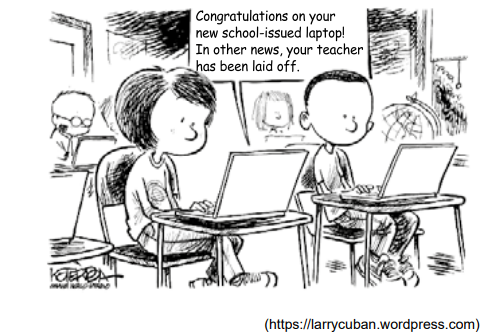 A imagem e as palavras na charge retratam a hipótese receada pelo autor do texto, qual seja,
Escolha quais comentários gostaria de ver