Questões de concursos

Filtrado por:
As alterações serão aplicadas ao filtrar.
Encontradas 123 questões
Texto associado

Texto 1


“Como é que sei tudo o que vai se seguir e que ainda o desconheço, já que nunca o vivi? É que numa rua do Rio de Janeiro peguei no ar de relance o sentimento de perdição no rosto de uma moça nordestina. Sem falar que eu em menino me criei no Nordeste. […]

A história – determino com falso livre-arbítrio – vai ter uns sete personagens e eu sou um dos mais importantes deles, é claro. Eu, Rodrigo S. M. Relato antigo, este, pois não quero ser mordenoso e inventar modismos à guisa de originalidade. […] O que é mais do que invenção, é minha obrigação contar sobre essa moça entre milhares delas. É dever meu, nem que seja de pouca arte, o de revelar-lhe a vida. Porque há o direito ao grito.”

LISPECTOR, Clarice. A hora da estrela. Rio de Janeiro: Rocco, 1998. p. 11-12.

Texto 2

Nos primeiros momentos, antes ainda de meu olhar pousar sobre a moça, levada pela tamanha sofrência que as pessoas traduziam da vida para ela, fui logo pensando na via-crúcis da existência de Macabéa. […] Se ele [Flaubert], para se defender da severa moral da época, precisou afirmar que Emma Bovary era ele, eu não preciso de nenhum ardil para garantir que Macabéa, a Flor de Mulungu, sou eu. Tal é a minha parecença-mulher com ela. Repito, sou eu e são todos os meus.”

EVARISTO, Conceição. Macabéa, Flor de Mulungu. Rio de Janeiro: Oficina Raquel, 2023. p. 11.

Texto 3

kurupira

passo de ida é caminho da volta
andar pra frente com os pés virados
pra trás não é folclore
é futuro.

WASSU, Ellen Lima. YBY KÛATIARA - UM LIVRO DE TERRA. Cotia: Urutau, 2023. p.63.

No Texto 1, o narrador Rodrigo S. M. afirma expressamente a sua relevância na hierarquia do relato: “eu sou um dos mais importantes deles, é claro. Eu, Rodrigo S. M.”, instaurando uma centralidade egoica em que o narrador-criador se coloca em destaque em relação à personagem retratada.

Em contrapartida, no Texto 2, a narradora de Conceição Evaristo reconfigura essa relação entre a voz que narra e a figura representada ao:

😭 Você errou!   Resposta: 😘 Parabéns! Você acertou!

Escolha quais comentários gostaria de ver

Carregando marcador...

COMO A MIA PODE AJUDAR?

🔒 Tire sua dúvidaDisponível nos planos pagos.
🔒 Plano de revisãoUtilize a MIA para gerar um plano de revisão com base no seu desempenho na plataforma.

Compartilhe esta questão

Envie para quem também está estudando.

Texto associado

Digital Literacy and Critical Thinking


Digital technologies have increased students’ access to information; however, access alone does not guarantee the development of critical thinking. Educators must design learning activities that encourage learners to evaluate sources, compare perspectives, and identify implicit assumptions. When students understand how an author’s purpose influences the presentation of information, they become better equipped to question claims that might otherwise appear unquestionable. Furthermore, they should examine alternative explanations in order to avoid interpretations based exclusively on a single perspective. Digital tools can contribute to this process, provided that they are integrated into meaningful pedagogical practices. For instance, students may compare conflicting online reports before writing an argumentative essay, which requires them to distinguish evidence from opinion. Not only does this activity enhance linguistic competence, but it also develops the ability to construct evidence-based arguments. Consequently, digital literacy should be understood not simply as the capacity to access information, but as the ability to interpret, evaluate, and use it responsibly.

Based on text 2, analyze the syntactic structures and logical relationships established by subordinate clauses, coordinate constructions, and discourse connectors, and mark the correct alternative.

😭 Você errou!   Resposta: 😘 Parabéns! Você acertou!

Escolha quais comentários gostaria de ver

Carregando marcador...

COMO A MIA PODE AJUDAR?

🔒 Tire sua dúvidaDisponível nos planos pagos.
🔒 Plano de revisãoUtilize a MIA para gerar um plano de revisão com base no seu desempenho na plataforma.

Compartilhe esta questão

Envie para quem também está estudando.

Texto associado

When Information Becomes Noise


In an age when information travels faster than reflection, being well-informed has become an increasingly complicated task. Digital platforms offer unprecedented access to news, scientific research and public debate; nevertheless, access should not be mistaken for understanding. The ability to retrieve information does not necessarily imply the ability to evaluate ________ credibility, recognize ________ ideological assumptions or interpret ________ broader implications.

One reason for this paradox is that online environments often reward immediacy, emotional intensity and constant engagement. Headlines are designed to capture attention, short videos compress complex arguments into easily digestible fragments, and recommendation algorithms tend to prioritize content likely to sustain users’ interest. Although these mechanisms can facilitate discovery, they may also reinforce existing beliefs and reduce exposure to competing perspectives.

The problem, however, cannot be attributed exclusively to technology. Readers actively participate in the construction of their information environments. When individuals share a claim without checking its source, mistake popularity for reliability or dismiss contradictory evidence as inherently suspicious, they contribute to the circulation of misinformation. Such practices reveal that digital literacy involves not merely technical competence but also intellectual responsibility.

A more critical approach requires readers to examine who produced a message, what evidence supports it, which voices are represented or excluded, and what purpose the communication serves. It also requires distinguishing between facts, interpretations and value judgments. An article may contain accurate information while arranging it in a way that encourages a particular conclusion; similarly, a photograph may document a real event without providing sufficient context to explain it.

Educational institutions therefore face a challenge that extends beyond teaching students how to operate digital tools. They must cultivate habits of inquiry, encourage the comparison of independent sources and create opportunities for learners to question assumptions, revise conclusions and justify their interpretations. Such practices do not eliminate uncertainty; rather, they help students respond to uncertainty with informed judgment instead of unquestioning acceptance.

Ultimately, the central question is not whether digital information is beneficial or harmful. It is whether readers possess the interpretive skills necessary to navigate an environment in which visibility does not guarantee truth and confidence does not necessarily indicate knowledge. In this context, critical reading becomes more than an academic exercise: it is a condition for meaningful participation in democratic life.

Word stress is the relative emphasis or prominence given to a specific syllable in a multisyllable word. Consider the word “information”, which appears repeatedly in academic and media-related discourse.

Which alternative correctly identifies its primary lexical stress and explains its relevance to pronunciation?

😭 Você errou!   Resposta: 😘 Parabéns! Você acertou!

Escolha quais comentários gostaria de ver

Carregando marcador...

COMO A MIA PODE AJUDAR?

🔒 Tire sua dúvidaDisponível nos planos pagos.
🔒 Plano de revisãoUtilize a MIA para gerar um plano de revisão com base no seu desempenho na plataforma.

Compartilhe esta questão

Envie para quem também está estudando.

Texto associado

When Information Becomes Noise


In an age when information travels faster than reflection, being well-informed has become an increasingly complicated task. Digital platforms offer unprecedented access to news, scientific research and public debate; nevertheless, access should not be mistaken for understanding. The ability to retrieve information does not necessarily imply the ability to evaluate ________ credibility, recognize ________ ideological assumptions or interpret ________ broader implications.

One reason for this paradox is that online environments often reward immediacy, emotional intensity and constant engagement. Headlines are designed to capture attention, short videos compress complex arguments into easily digestible fragments, and recommendation algorithms tend to prioritize content likely to sustain users’ interest. Although these mechanisms can facilitate discovery, they may also reinforce existing beliefs and reduce exposure to competing perspectives.

The problem, however, cannot be attributed exclusively to technology. Readers actively participate in the construction of their information environments. When individuals share a claim without checking its source, mistake popularity for reliability or dismiss contradictory evidence as inherently suspicious, they contribute to the circulation of misinformation. Such practices reveal that digital literacy involves not merely technical competence but also intellectual responsibility.

A more critical approach requires readers to examine who produced a message, what evidence supports it, which voices are represented or excluded, and what purpose the communication serves. It also requires distinguishing between facts, interpretations and value judgments. An article may contain accurate information while arranging it in a way that encourages a particular conclusion; similarly, a photograph may document a real event without providing sufficient context to explain it.

Educational institutions therefore face a challenge that extends beyond teaching students how to operate digital tools. They must cultivate habits of inquiry, encourage the comparison of independent sources and create opportunities for learners to question assumptions, revise conclusions and justify their interpretations. Such practices do not eliminate uncertainty; rather, they help students respond to uncertainty with informed judgment instead of unquestioning acceptance.

Ultimately, the central question is not whether digital information is beneficial or harmful. It is whether readers possess the interpretive skills necessary to navigate an environment in which visibility does not guarantee truth and confidence does not necessarily indicate knowledge. In this context, critical reading becomes more than an academic exercise: it is a condition for meaningful participation in democratic life.

English phonetics requires learners to distinguish individual speech sounds, including consonants that may be unfamiliar to speakers of other languages.

Consider the English word “think”, pronounced /θɪŋk/.

Which alternative correctly describes the initial consonant /θ/?

😭 Você errou!   Resposta: 😘 Parabéns! Você acertou!

Escolha quais comentários gostaria de ver

Carregando marcador...

COMO A MIA PODE AJUDAR?

🔒 Tire sua dúvidaDisponível nos planos pagos.
🔒 Plano de revisãoUtilize a MIA para gerar um plano de revisão com base no seu desempenho na plataforma.

Compartilhe esta questão

Envie para quem também está estudando.

Texto associado

When Information Becomes Noise


In an age when information travels faster than reflection, being well-informed has become an increasingly complicated task. Digital platforms offer unprecedented access to news, scientific research and public debate; nevertheless, access should not be mistaken for understanding. The ability to retrieve information does not necessarily imply the ability to evaluate ________ credibility, recognize ________ ideological assumptions or interpret ________ broader implications.

One reason for this paradox is that online environments often reward immediacy, emotional intensity and constant engagement. Headlines are designed to capture attention, short videos compress complex arguments into easily digestible fragments, and recommendation algorithms tend to prioritize content likely to sustain users’ interest. Although these mechanisms can facilitate discovery, they may also reinforce existing beliefs and reduce exposure to competing perspectives.

The problem, however, cannot be attributed exclusively to technology. Readers actively participate in the construction of their information environments. When individuals share a claim without checking its source, mistake popularity for reliability or dismiss contradictory evidence as inherently suspicious, they contribute to the circulation of misinformation. Such practices reveal that digital literacy involves not merely technical competence but also intellectual responsibility.

A more critical approach requires readers to examine who produced a message, what evidence supports it, which voices are represented or excluded, and what purpose the communication serves. It also requires distinguishing between facts, interpretations and value judgments. An article may contain accurate information while arranging it in a way that encourages a particular conclusion; similarly, a photograph may document a real event without providing sufficient context to explain it.

Educational institutions therefore face a challenge that extends beyond teaching students how to operate digital tools. They must cultivate habits of inquiry, encourage the comparison of independent sources and create opportunities for learners to question assumptions, revise conclusions and justify their interpretations. Such practices do not eliminate uncertainty; rather, they help students respond to uncertainty with informed judgment instead of unquestioning acceptance.

Ultimately, the central question is not whether digital information is beneficial or harmful. It is whether readers possess the interpretive skills necessary to navigate an environment in which visibility does not guarantee truth and confidence does not necessarily indicate knowledge. In this context, critical reading becomes more than an academic exercise: it is a condition for meaningful participation in democratic life.

According to the following topics: Word formation and morphological analysis, examine the following words taken from or directly related to the text:

1. misinformation

2. unquestioning

3. reliability

4. intellectual

5. interpretive

Which alternative correctly analyzes the word-formation processes involved?

😭 Você errou!   Resposta: 😘 Parabéns! Você acertou!

Escolha quais comentários gostaria de ver

Carregando marcador...

COMO A MIA PODE AJUDAR?

🔒 Tire sua dúvidaDisponível nos planos pagos.
🔒 Plano de revisãoUtilize a MIA para gerar um plano de revisão com base no seu desempenho na plataforma.

Compartilhe esta questão

Envie para quem também está estudando.

Texto associado

When Information Becomes Noise


In an age when information travels faster than reflection, being well-informed has become an increasingly complicated task. Digital platforms offer unprecedented access to news, scientific research and public debate; nevertheless, access should not be mistaken for understanding. The ability to retrieve information does not necessarily imply the ability to evaluate ________ credibility, recognize ________ ideological assumptions or interpret ________ broader implications.

One reason for this paradox is that online environments often reward immediacy, emotional intensity and constant engagement. Headlines are designed to capture attention, short videos compress complex arguments into easily digestible fragments, and recommendation algorithms tend to prioritize content likely to sustain users’ interest. Although these mechanisms can facilitate discovery, they may also reinforce existing beliefs and reduce exposure to competing perspectives.

The problem, however, cannot be attributed exclusively to technology. Readers actively participate in the construction of their information environments. When individuals share a claim without checking its source, mistake popularity for reliability or dismiss contradictory evidence as inherently suspicious, they contribute to the circulation of misinformation. Such practices reveal that digital literacy involves not merely technical competence but also intellectual responsibility.

A more critical approach requires readers to examine who produced a message, what evidence supports it, which voices are represented or excluded, and what purpose the communication serves. It also requires distinguishing between facts, interpretations and value judgments. An article may contain accurate information while arranging it in a way that encourages a particular conclusion; similarly, a photograph may document a real event without providing sufficient context to explain it.

Educational institutions therefore face a challenge that extends beyond teaching students how to operate digital tools. They must cultivate habits of inquiry, encourage the comparison of independent sources and create opportunities for learners to question assumptions, revise conclusions and justify their interpretations. Such practices do not eliminate uncertainty; rather, they help students respond to uncertainty with informed judgment instead of unquestioning acceptance.

Ultimately, the central question is not whether digital information is beneficial or harmful. It is whether readers possess the interpretive skills necessary to navigate an environment in which visibility does not guarantee truth and confidence does not necessarily indicate knowledge. In this context, critical reading becomes more than an academic exercise: it is a condition for meaningful participation in democratic life.

Read the following paragraph from Text 1.

The ability to retrieve information does not necessarily imply the ability to evaluate ________________ credibility, recognize ________________ ideological assumptions or interpret ________________ broader implications.

Select the alternative that correctly fills in all the blanks in the text.

😭 Você errou!   Resposta: 😘 Parabéns! Você acertou!

Escolha quais comentários gostaria de ver

Carregando marcador...

COMO A MIA PODE AJUDAR?

🔒 Tire sua dúvidaDisponível nos planos pagos.
🔒 Plano de revisãoUtilize a MIA para gerar um plano de revisão com base no seu desempenho na plataforma.

Compartilhe esta questão

Envie para quem também está estudando.

Texto associado

When Information Becomes Noise


In an age when information travels faster than reflection, being well-informed has become an increasingly complicated task. Digital platforms offer unprecedented access to news, scientific research and public debate; nevertheless, access should not be mistaken for understanding. The ability to retrieve information does not necessarily imply the ability to evaluate ________ credibility, recognize ________ ideological assumptions or interpret ________ broader implications.

One reason for this paradox is that online environments often reward immediacy, emotional intensity and constant engagement. Headlines are designed to capture attention, short videos compress complex arguments into easily digestible fragments, and recommendation algorithms tend to prioritize content likely to sustain users’ interest. Although these mechanisms can facilitate discovery, they may also reinforce existing beliefs and reduce exposure to competing perspectives.

The problem, however, cannot be attributed exclusively to technology. Readers actively participate in the construction of their information environments. When individuals share a claim without checking its source, mistake popularity for reliability or dismiss contradictory evidence as inherently suspicious, they contribute to the circulation of misinformation. Such practices reveal that digital literacy involves not merely technical competence but also intellectual responsibility.

A more critical approach requires readers to examine who produced a message, what evidence supports it, which voices are represented or excluded, and what purpose the communication serves. It also requires distinguishing between facts, interpretations and value judgments. An article may contain accurate information while arranging it in a way that encourages a particular conclusion; similarly, a photograph may document a real event without providing sufficient context to explain it.

Educational institutions therefore face a challenge that extends beyond teaching students how to operate digital tools. They must cultivate habits of inquiry, encourage the comparison of independent sources and create opportunities for learners to question assumptions, revise conclusions and justify their interpretations. Such practices do not eliminate uncertainty; rather, they help students respond to uncertainty with informed judgment instead of unquestioning acceptance.

Ultimately, the central question is not whether digital information is beneficial or harmful. It is whether readers possess the interpretive skills necessary to navigate an environment in which visibility does not guarantee truth and confidence does not necessarily indicate knowledge. In this context, critical reading becomes more than an academic exercise: it is a condition for meaningful participation in democratic life.

Study these sentences and decide if they are true ( T ) or false ( F ), according to structure and grammar use.

( ) In the following sentence from the text: “Although these mechanisms can facilitate discovery, they may also reinforce existing beliefs and reduce exposure to competing perspectives.”, the underlined word introduces a concession.

( ) Consider the following sentence: “These mechanisms can facilitate discovery, but they may also reinforce existing beliefs.”, the words in bold are modal verbs: Can expresses capability or possibility; may signals a possible outcome rather than certainty.

( ) “Headlines are designed to capture attention,…”, the verb tense used in the sentence from the text is the Simple Present Tense.

( ) In the sentence from the text: “Readers actively participate in the construction of their information environments.”, the underlined word refers to the word ‘Readers’.

( ) The negative form for: “It also requires distinguishing between facts, interpretations and value judgments.”, is “It also doesn’t require distinguishing between facts, interpretations and value judgments.”

Choose the alternative, which presents the correct sequence, from top to bottom:

😭 Você errou!   Resposta: 😘 Parabéns! Você acertou!

Escolha quais comentários gostaria de ver

Carregando marcador...

COMO A MIA PODE AJUDAR?

🔒 Tire sua dúvidaDisponível nos planos pagos.
🔒 Plano de revisãoUtilize a MIA para gerar um plano de revisão com base no seu desempenho na plataforma.

Compartilhe esta questão

Envie para quem também está estudando.

Texto associado

When Information Becomes Noise


In an age when information travels faster than reflection, being well-informed has become an increasingly complicated task. Digital platforms offer unprecedented access to news, scientific research and public debate; nevertheless, access should not be mistaken for understanding. The ability to retrieve information does not necessarily imply the ability to evaluate ________ credibility, recognize ________ ideological assumptions or interpret ________ broader implications.

One reason for this paradox is that online environments often reward immediacy, emotional intensity and constant engagement. Headlines are designed to capture attention, short videos compress complex arguments into easily digestible fragments, and recommendation algorithms tend to prioritize content likely to sustain users’ interest. Although these mechanisms can facilitate discovery, they may also reinforce existing beliefs and reduce exposure to competing perspectives.

The problem, however, cannot be attributed exclusively to technology. Readers actively participate in the construction of their information environments. When individuals share a claim without checking its source, mistake popularity for reliability or dismiss contradictory evidence as inherently suspicious, they contribute to the circulation of misinformation. Such practices reveal that digital literacy involves not merely technical competence but also intellectual responsibility.

A more critical approach requires readers to examine who produced a message, what evidence supports it, which voices are represented or excluded, and what purpose the communication serves. It also requires distinguishing between facts, interpretations and value judgments. An article may contain accurate information while arranging it in a way that encourages a particular conclusion; similarly, a photograph may document a real event without providing sufficient context to explain it.

Educational institutions therefore face a challenge that extends beyond teaching students how to operate digital tools. They must cultivate habits of inquiry, encourage the comparison of independent sources and create opportunities for learners to question assumptions, revise conclusions and justify their interpretations. Such practices do not eliminate uncertainty; rather, they help students respond to uncertainty with informed judgment instead of unquestioning acceptance.

Ultimately, the central question is not whether digital information is beneficial or harmful. It is whether readers possess the interpretive skills necessary to navigate an environment in which visibility does not guarantee truth and confidence does not necessarily indicate knowledge. In this context, critical reading becomes more than an academic exercise: it is a condition for meaningful participation in democratic life.

In the sentence “Such practices reveal that digital literacy involves not merely technical competence but also intellectual responsibility”, the expression “not merely … but also”, establishes a relationship of:

😭 Você errou!   Resposta: 😘 Parabéns! Você acertou!

Escolha quais comentários gostaria de ver

Carregando marcador...

COMO A MIA PODE AJUDAR?

🔒 Tire sua dúvidaDisponível nos planos pagos.
🔒 Plano de revisãoUtilize a MIA para gerar um plano de revisão com base no seu desempenho na plataforma.

Compartilhe esta questão

Envie para quem também está estudando.

Texto associado

When Information Becomes Noise


In an age when information travels faster than reflection, being well-informed has become an increasingly complicated task. Digital platforms offer unprecedented access to news, scientific research and public debate; nevertheless, access should not be mistaken for understanding. The ability to retrieve information does not necessarily imply the ability to evaluate ________ credibility, recognize ________ ideological assumptions or interpret ________ broader implications.

One reason for this paradox is that online environments often reward immediacy, emotional intensity and constant engagement. Headlines are designed to capture attention, short videos compress complex arguments into easily digestible fragments, and recommendation algorithms tend to prioritize content likely to sustain users’ interest. Although these mechanisms can facilitate discovery, they may also reinforce existing beliefs and reduce exposure to competing perspectives.

The problem, however, cannot be attributed exclusively to technology. Readers actively participate in the construction of their information environments. When individuals share a claim without checking its source, mistake popularity for reliability or dismiss contradictory evidence as inherently suspicious, they contribute to the circulation of misinformation. Such practices reveal that digital literacy involves not merely technical competence but also intellectual responsibility.

A more critical approach requires readers to examine who produced a message, what evidence supports it, which voices are represented or excluded, and what purpose the communication serves. It also requires distinguishing between facts, interpretations and value judgments. An article may contain accurate information while arranging it in a way that encourages a particular conclusion; similarly, a photograph may document a real event without providing sufficient context to explain it.

Educational institutions therefore face a challenge that extends beyond teaching students how to operate digital tools. They must cultivate habits of inquiry, encourage the comparison of independent sources and create opportunities for learners to question assumptions, revise conclusions and justify their interpretations. Such practices do not eliminate uncertainty; rather, they help students respond to uncertainty with informed judgment instead of unquestioning acceptance.

Ultimately, the central question is not whether digital information is beneficial or harmful. It is whether readers possess the interpretive skills necessary to navigate an environment in which visibility does not guarantee truth and confidence does not necessarily indicate knowledge. In this context, critical reading becomes more than an academic exercise: it is a condition for meaningful participation in democratic life.

Which alternative identifies correctly the central purpose of the text and its intended audience?

😭 Você errou!   Resposta: 😘 Parabéns! Você acertou!

Escolha quais comentários gostaria de ver

Carregando marcador...

COMO A MIA PODE AJUDAR?

🔒 Tire sua dúvidaDisponível nos planos pagos.
🔒 Plano de revisãoUtilize a MIA para gerar um plano de revisão com base no seu desempenho na plataforma.

Compartilhe esta questão

Envie para quem também está estudando.

Texto associado

When Information Becomes Noise


In an age when information travels faster than reflection, being well-informed has become an increasingly complicated task. Digital platforms offer unprecedented access to news, scientific research and public debate; nevertheless, access should not be mistaken for understanding. The ability to retrieve information does not necessarily imply the ability to evaluate ________ credibility, recognize ________ ideological assumptions or interpret ________ broader implications.

One reason for this paradox is that online environments often reward immediacy, emotional intensity and constant engagement. Headlines are designed to capture attention, short videos compress complex arguments into easily digestible fragments, and recommendation algorithms tend to prioritize content likely to sustain users’ interest. Although these mechanisms can facilitate discovery, they may also reinforce existing beliefs and reduce exposure to competing perspectives.

The problem, however, cannot be attributed exclusively to technology. Readers actively participate in the construction of their information environments. When individuals share a claim without checking its source, mistake popularity for reliability or dismiss contradictory evidence as inherently suspicious, they contribute to the circulation of misinformation. Such practices reveal that digital literacy involves not merely technical competence but also intellectual responsibility.

A more critical approach requires readers to examine who produced a message, what evidence supports it, which voices are represented or excluded, and what purpose the communication serves. It also requires distinguishing between facts, interpretations and value judgments. An article may contain accurate information while arranging it in a way that encourages a particular conclusion; similarly, a photograph may document a real event without providing sufficient context to explain it.

Educational institutions therefore face a challenge that extends beyond teaching students how to operate digital tools. They must cultivate habits of inquiry, encourage the comparison of independent sources and create opportunities for learners to question assumptions, revise conclusions and justify their interpretations. Such practices do not eliminate uncertainty; rather, they help students respond to uncertainty with informed judgment instead of unquestioning acceptance.

Ultimately, the central question is not whether digital information is beneficial or harmful. It is whether readers possess the interpretive skills necessary to navigate an environment in which visibility does not guarantee truth and confidence does not necessarily indicate knowledge. In this context, critical reading becomes more than an academic exercise: it is a condition for meaningful participation in democratic life.

Based on Text 1, determine whether the following statements are True ( T ) or False ( F ).

( ) The text argues that access to a large amount of digital information does not necessarily result in deeper understanding or critical judgment.

( ) The author maintains that technology is solely responsible for misinformation because readers have no meaningful influence on the circulation of digital content.

( ) The text suggests that recommendation algorithms may reinforce existing beliefs by limiting users’ exposure to competing perspectives.

( ) According to the author, critical reading eliminates uncertainty by enabling readers to establish absolute truth in every communicative situation.

( ) The author considers critical reading essential not only for academic development but also for meaningful participation in democratic life.

Choose the alternative, which presents the correct sequence, from top to bottom:

😭 Você errou!   Resposta: 😘 Parabéns! Você acertou!

Escolha quais comentários gostaria de ver

Carregando marcador...

COMO A MIA PODE AJUDAR?

🔒 Tire sua dúvidaDisponível nos planos pagos.
🔒 Plano de revisãoUtilize a MIA para gerar um plano de revisão com base no seu desempenho na plataforma.

Compartilhe esta questão

Envie para quem também está estudando.

Identifique abaixo as afirmativas verdadeiras ( V ) e falsas ( F ) considerando o uso crítico e responsável das tecnologias digitais no ensino e na aprendizagem de Língua Inglesa.

( ) A avaliação crítica de fontes digitais em Língua Inglesa deve considerar a autoria, a credibilidade, a atualidade, as evidências apresentadas e os interesses que podem influenciar a produção e a circulação das informações.

( ) A utilização de ferramentas digitais de tradução automática e inteligência artificial dispensa a revisão linguística e contextual dos conteúdos produzidos pelos estudantes, uma vez que essas tecnologias garantem a precisão dos significados e a adequação comunicativa.

( ) A produção e o compartilhamento responsável de conteúdos digitais exigem o respeito aos direitos autorais, à privacidade, à proteção de dados pessoais e à diversidade cultural, além da verificação das informações divulgadas.

( ) A análise crítica de discursos midiáticos pressupõe reconhecer que textos, imagens e vídeos podem construir representações sociais específicas, reproduzir estereótipos e influenciar a interpretação dos acontecimentos.

( ) O emprego de plataformas digitais no ensino de Língua Inglesa deve priorizar a quantidade de conteúdos acessados e compartilhados, independentemente da qualidade das fontes, dos objetivos pedagógicos e do desenvolvimento da autonomia crítica dos estudantes.

Assinale a alternativa que indica a sequência correta, de cima para baixo.

😭 Você errou!   Resposta: 😘 Parabéns! Você acertou!

Escolha quais comentários gostaria de ver

Carregando marcador...

COMO A MIA PODE AJUDAR?

🔒 Tire sua dúvidaDisponível nos planos pagos.
🔒 Plano de revisãoUtilize a MIA para gerar um plano de revisão com base no seu desempenho na plataforma.

Compartilhe esta questão

Envie para quem também está estudando.

Leia o parágrafo a seguir com atenção:

‘Uma professora de Língua Inglesa propõe uma atividade na qual os estudantes devem pesquisar, em diferentes fontes digitais, informações sobre os impactos da inteligência artificial na educação. Em seguida, deverão produzir um infográfico em inglês, inserir links para as fontes consultadas e compartilhar o material em um ambiente virtual da turma.’

Analise as afirmativas a seguir, considerando os princípios dos multiletramentos, a multimodalidade, a cultura participativa e o uso responsável das tecnologias digitais.

1. A comparação entre diferentes fontes permite desenvolver a leitura crítica em Língua Inglesa, especialmente quando os estudantes analisam autoria, evidências, atualidade, finalidade comunicativa e possíveis interesses envolvidos na divulgação das informações.

2. A produção de um infográfico caracteriza uma prática multimodal, pois articula elementos verbais e visuais para organizar e comunicar informações, exigindo escolhas relacionadas ao público, ao propósito e à clareza da mensagem.

3. O compartilhamento do material em ambiente virtual torna desnecessária a verificação das informações e das referências, uma vez que os conteúdos produzidos coletivamente tendem a apresentar maior confiabilidade.

4. O uso de ferramentas digitais pode favorecer a aprendizagem do idioma, quando está associado a objetivos pedagógicos claros, à interação entre os estudantes, à produção significativa de linguagem e à mediação docente.

5. A análise crítica dos discursos midiáticos deve considerar que textos e imagens podem apresentar perspectivas, interesses e representações culturais específicas, sendo importante questionar estereótipos e distinguir evidências de opiniões.

Assinale a alternativa que indica todas as afirmativas corretas.

😭 Você errou!   Resposta: 😘 Parabéns! Você acertou!

Escolha quais comentários gostaria de ver

Carregando marcador...

COMO A MIA PODE AJUDAR?

🔒 Tire sua dúvidaDisponível nos planos pagos.
🔒 Plano de revisãoUtilize a MIA para gerar um plano de revisão com base no seu desempenho na plataforma.

Compartilhe esta questão

Envie para quem também está estudando.

Identifique abaixo as afirmativas verdadeiras ( V ) e falsas ( F ), considerando os pressupostos das Diretrizes Curriculares da Educação Básica do Sistema Público Municipal de Campos Novos, especialmente no que se refere à Educação Infantil e ao eixo Linguagem Oral e Escrita.

( ) A linguagem oral e escrita constitui um dos eixos básicos da Educação Infantil, contribuindo para a formação do sujeito, a interação social, o desenvolvimento do pensamento e a construção do conhecimento.

( ) O desenvolvimento da linguagem infantil inicia-se somente quando a criança ingressa na escola e passa a ter contato sistemático com atividades de alfabetização.

( ) Gestos, movimentos corporais, expressões faciais e balbucios constituem formas de comunicação presentes desde os primeiros momentos da vida da criança.

( ) A estimulação sonora realizada pela família e ampliada pela instituição educativa pode contribuir para a aquisição, a ampliação e o enriquecimento do vocabulário infantil.

( ) A linguagem oral e escrita deve ser trabalhada exclusivamente como preparação para a alfabetização formal, sem relação com a expressão de sentimentos, a interação social e o conhecimento de diferentes culturas.

Assinale a alternativa que indica a sequência correta, de cima para baixo.

😭 Você errou!   Resposta: 😘 Parabéns! Você acertou!

Escolha quais comentários gostaria de ver

Carregando marcador...

COMO A MIA PODE AJUDAR?

🔒 Tire sua dúvidaDisponível nos planos pagos.
🔒 Plano de revisãoUtilize a MIA para gerar um plano de revisão com base no seu desempenho na plataforma.

Compartilhe esta questão

Envie para quem também está estudando.

Leia as instruções de um formulário de inscrição para um programa de intercâmbio.

Student Exchange Application

Application instructions

1. Complete all required fields using accurate information.

2. Upload a short statement explaining your motivation for joining the program.

3. Review your answers before submitting the form.

4. Applications received after October 30 will not be considered.

Required fields

Full name · Email address · School · Preferred destination

Assinale a alternativa correta considerando a finalidade e a organização dos gêneros instrução e formulário.

😭 Você errou!   Resposta: 😘 Parabéns! Você acertou!

Escolha quais comentários gostaria de ver

Carregando marcador...

COMO A MIA PODE AJUDAR?

🔒 Tire sua dúvidaDisponível nos planos pagos.
🔒 Plano de revisãoUtilize a MIA para gerar um plano de revisão com base no seu desempenho na plataforma.

Compartilhe esta questão

Envie para quem também está estudando.

Um infográfico educacional apresenta os seguintes dados fictícios sobre as preferências de leitura de um grupo de estudantes:
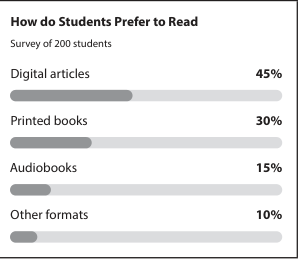
Assinale a alternativa correta considerando as especificidades do gênero infográfico e a interpretação dos dados apresentados.

😭 Você errou!   Resposta: 😘 Parabéns! Você acertou!

Escolha quais comentários gostaria de ver

Carregando marcador...

COMO A MIA PODE AJUDAR?

🔒 Tire sua dúvidaDisponível nos planos pagos.
🔒 Plano de revisãoUtilize a MIA para gerar um plano de revisão com base no seu desempenho na plataforma.

Compartilhe esta questão

Envie para quem também está estudando.

Acerca do tema: Gêneros discursivos e práticas sociais de linguagem, leia a mensagem abaixo:

“Group Chat – English Project

8:42 p.m. — Mia

Hey everyone! I’ve just checked the teacher’s feedback. We need to revise the introduction and add reliable sources before Friday. Could someone double-check the references? I’ll update the slides tonight. Thanks a bunch!”

Assinale a alternativa correta com base nas características do gênero ‘mensagem digital’ e em sua finalidade comunicativa.

😭 Você errou!   Resposta: 😘 Parabéns! Você acertou!

Escolha quais comentários gostaria de ver

Carregando marcador...

COMO A MIA PODE AJUDAR?

🔒 Tire sua dúvidaDisponível nos planos pagos.
🔒 Plano de revisãoUtilize a MIA para gerar um plano de revisão com base no seu desempenho na plataforma.

Compartilhe esta questão

Envie para quem também está estudando.

Identifique abaixo as afirmativas verdadeiras ( V ) e falsas ( F ) referentes ao eixo Oralidade no ensino de Língua Inglesa.

( ) O desenvolvimento da oralidade deve priorizar a reprodução de diálogos previamente memorizados, pois a espontaneidade e a negociação de sentidos não constituem objetivos relevantes para a aprendizagem.

( ) A compreensão oral envolve a mobilização de estratégias para interpretar enunciados, identificar informações e construir sentidos de acordo com a situação comunicativa.

( ) A pronúncia, a entonação e o ritmo devem ser abordados exclusivamente como mecanismos de imitação de falantes nativos, sem considerar a inteligibilidade e a diversidade de usos do idioma.

( ) Atividades de interação oral podem contribuir para o desenvolvimento da autonomia comunicativa, da participação social e da capacidade de negociar significados em Língua Inglesa.

( ) O eixo Oralidade envolve práticas de compreensão e produção oral em diferentes contextos comunicativos, considerando os interlocutores, os objetivos e as condições de interação.

Assinale a alternativa que indica a sequência correta, de cima para baixo.

😭 Você errou!   Resposta: 😘 Parabéns! Você acertou!

Escolha quais comentários gostaria de ver

Carregando marcador...

COMO A MIA PODE AJUDAR?

🔒 Tire sua dúvidaDisponível nos planos pagos.
🔒 Plano de revisãoUtilize a MIA para gerar um plano de revisão com base no seu desempenho na plataforma.

Compartilhe esta questão

Envie para quem também está estudando.

Sobre o tema ‘Integração dos eixos e planejamento pedagógico’, analise o parágrafo abaixo:

Uma professora de Língua Inglesa planeja uma sequência didática sobre o tema ‘Digital Communication’ and ‘Cultural Diversity’. Os estudantes analisam publicações digitais em inglês, discutem diferenças culturais, produzem comentários para um fórum e apresentam oralmente suas conclusões.

Analise as afirmativas abaixo com base na proposta e nos princípios da BNCC.

1. A sequência didática pode integrar os eixos Leitura, Escrita, Oralidade, Conhecimentos Linguísticos e Dimensão Intercultural em torno de uma situação comunicativa significativa.

2. A análise de publicações digitais não pode ser considerada prática de leitura, pois esse eixo se restringe a textos impressos e a materiais didáticos convencionais.

3. A produção de comentários para um fórum envolve decisões sobre gênero textual, interlocutores, propósito comunicativo e recursos linguísticos adequados à situação.

4. A discussão sobre diferenças culturais deve ser excluída do ensino de Língua Inglesa, uma vez que os aspectos socioculturais não fazem parte das aprendizagens previstas para o componente curricular.

5. A avaliação da sequência pode considerar tanto os conhecimentos linguísticos quanto a capacidade de interpretar informações, produzir textos adequados e participar criticamente das interações.

Assinale a alternativa que indica todas as afirmativas corretas.

😭 Você errou!   Resposta: 😘 Parabéns! Você acertou!

Escolha quais comentários gostaria de ver

Carregando marcador...

COMO A MIA PODE AJUDAR?

🔒 Tire sua dúvidaDisponível nos planos pagos.
🔒 Plano de revisãoUtilize a MIA para gerar um plano de revisão com base no seu desempenho na plataforma.

Compartilhe esta questão

Envie para quem também está estudando.

Identifique abaixo as afirmativas verdadeiras ( V ) e falsas ( F ) sobre os objetivos do ensino de Língua Inglesa na Educação Básica, conforme os pressupostos da BNCC.

( ) O ensino de Língua Inglesa deve possibilitar aos estudantes a participação em práticas sociais de linguagem, ampliando suas possibilidades de interação em contextos locais e globais.

( ) O desenvolvimento da competência comunicativa pressupõe o domínio exclusivo das normas gramaticais da variedade considerada padrão, uma vez que outras variedades linguísticas comprometem a eficácia da comunicação.

( ) A aprendizagem da Língua Inglesa deve contribuir para a formação integral dos estudantes, favorecendo o pensamento crítico, a autonomia e o reconhecimento da diversidade cultural e linguística.

( ) A BNCC compreende a Língua Inglesa exclusivamente como instrumento de comunicação com falantes nativos de países anglófonos, priorizando os padrões linguísticos desses países.

( ) O ensino de Língua Inglesa deve favorecer o acesso a conhecimentos, culturas e diferentes formas de participação social, reconhecendo o idioma como língua franca.

Assinale a alternativa que indica a sequência correta, de cima para baixo.

😭 Você errou!   Resposta: 😘 Parabéns! Você acertou!

Escolha quais comentários gostaria de ver

Carregando marcador...

COMO A MIA PODE AJUDAR?

🔒 Tire sua dúvidaDisponível nos planos pagos.
🔒 Plano de revisãoUtilize a MIA para gerar um plano de revisão com base no seu desempenho na plataforma.

Compartilhe esta questão

Envie para quem também está estudando.

Leia com atenção as seguintes situações sobre o tema: Funções sociais da língua inglesa.

Uma pesquisadora brasileira lê artigos científicos em inglês.

Um profissional brasileiro participa de uma reunião virtual com colegas de diferentes países.

Um estudante utiliza plataformas digitais internacionais para aprender sobre programação.

Um turista brasileiro interage com pessoas de diferentes nacionalidades durante uma viagem.

Essas situações demonstram que:

😭 Você errou!   Resposta: 😘 Parabéns! Você acertou!

Escolha quais comentários gostaria de ver

Carregando marcador...

COMO A MIA PODE AJUDAR?

🔒 Tire sua dúvidaDisponível nos planos pagos.
🔒 Plano de revisãoUtilize a MIA para gerar um plano de revisão com base no seu desempenho na plataforma.

Compartilhe esta questão

Envie para quem também está estudando.