Questões de Inglês sobre Interpretação de texto | Reading Comprehension

Resolva questões de concursos de Inglês sobre Interpretação de texto | Reading Comprehension, filtre por banca, órgão, cargo e ano e acompanhe sua evolução.

Filtrado por:
As alterações serão aplicadas ao filtrar.
Encontradas 12 questões

The text mentions several cultural witch archetypes from different traditions, including Brazil's Cuca from "Sítio do Picapau Amarelo" and Mexico's "La Bruja del 71" from "El Chavo del Ocho." What cultural and linguistic purpose does the inclusion of these non-Anglo-American examples serve in the context of the text?

😭 Você errou!   Resposta: 😘 Parabéns! Você acertou!

Escolha quais comentários gostaria de ver

Carregando comentários dos alunos...
Carregando marcador...

MIA

Entenda a questão e transforme a dificuldade em um próximo passo de estudo.
Como a MIA pode ajudar?

🔒 Tire sua dúvidaDisponível nos planos pagos.
🔒 Plano de revisãoDisponível nos planos pagos.

In the concluding paragraph, the author asserts that "the portrayal of the witch is not monolithic." By employing this specific adjective, derived from geology but applied here to literary analysis, the author intends to communicate that the representation of the witch is NOT:

😭 Você errou!   Resposta: 😘 Parabéns! Você acertou!

Escolha quais comentários gostaria de ver

Carregando comentários dos alunos...
Carregando marcador...

MIA

Entenda a questão e transforme a dificuldade em um próximo passo de estudo.

Como a MIA pode ajudar?

🔒 Tire sua dúvidaDisponível nos planos pagos.
🔒 Plano de revisãoDisponível nos planos pagos.
Texto associado

The archetype of the classic witch is a cornerstone of global folklore and fiction, often depicted as a formidable and sinister antagonist. These figures are deeply embedded in collective storytelling, usually characterized by their malevolent intentions towards protagonists, especially innocent children or virtuous heroes. Their narrative role is fundamentally to embody the forces of darkness, chaos, or forbidden knowledge, creating a clear moral contrast and a formidable obstacle for the main characters to overcome. From European fairy tales to modern pop culture, the classic witch serves as a powerful symbol of fear and the supernatural.
Physically, the traditional witch is frequently described as an old, haggard woman with exaggeratedly ugly features, which visually symbolizes her inner corruption and alienation from societal norms. Common traits include a long, hooked nose, warts, disheveled gray hair, and crooked fingers. She is typically clothed in dark, ragged robes and a pointed, wide-brimmed hat, an image popularized and solidified by Western media. This distinct and fearsome appearance is designed to evoke immediate unease and signal her dangerous nature to the audience.
The classic witch's power is intrinsically linked to specific magical tools and practices. The bubbling cauldron is her quintessential instrument, used for brewing potent potions, casting spells, and concocting mysterious elixirs. Her magic often involves ancient books of spells, enchanted mirrors that show more than mere reflections, and the command over supernatural familiars like black cats, crows, or toads. These elements are not just props; they are extensions of her will and the sources of her power, which she uses to curse, transform, or deceive those who cross her path.
This archetype finds vivid expression in some of the most famous villains of literature and film. The Wicked Witch of the West from The Wizard of Oz menaces Dorothy with hercommand over flying monkeys and her thirst for revenge. The Evil Queen from Snow White, obsessed with being the "fairest of them all," uses a poisoned apple in her deadly scheme. Similarly, Maleficent from Sleeping Beauty is a figure of pure vengeance, cursing an infant princess to a sleep-like death. Beyond Anglo-American tales, other cultures have their own versions, such as Brazil's Cuca, a child-eating alligator-witch from SÌtio do Picapau Amarelo.
However, the portrayal of the witch is not monolithic and has evolved to include more nuanced or comedic figures. In the Mexican sitcom El Chavo del Ocho, DoÒa Clotilde, nicknamed "La Bruja del 71," is a neighborhood eccentric whose witch persona is more a source of gossip and lighthearted fear than genuine evil. Furthermore, modern narratives like the film Hocus Pocus present the Sanderson sisters as a blend of the classic tropes—complete with spell books and a thirst for youth—but with a comedic and less terrifying demeanor, showcasing the adaptability and enduring fascination with this iconic character type.

The word "haggard" in the second paragraph contains a specific vowel sound. Which of the following words from the text contains the same vowel sound as the first syllable of "haggard"?

😭 Você errou!   Resposta: 😘 Parabéns! Você acertou!

Escolha quais comentários gostaria de ver

Carregando comentários dos alunos...
Carregando marcador...

MIA

Entenda a questão e transforme a dificuldade em um próximo passo de estudo.

Como a MIA pode ajudar?

🔒 Tire sua dúvidaDisponível nos planos pagos.
🔒 Plano de revisãoDisponível nos planos pagos.
Texto associado

The archetype of the classic witch is a cornerstone of global folklore and fiction, often depicted as a formidable and sinister antagonist. These figures are deeply embedded in collective storytelling, usually characterized by their malevolent intentions towards protagonists, especially innocent children or virtuous heroes. Their narrative role is fundamentally to embody the forces of darkness, chaos, or forbidden knowledge, creating a clear moral contrast and a formidable obstacle for the main characters to overcome. From European fairy tales to modern pop culture, the classic witch serves as a powerful symbol of fear and the supernatural.
Physically, the traditional witch is frequently described as an old, haggard woman with exaggeratedly ugly features, which visually symbolizes her inner corruption and alienation from societal norms. Common traits include a long, hooked nose, warts, disheveled gray hair, and crooked fingers. She is typically clothed in dark, ragged robes and a pointed, wide-brimmed hat, an image popularized and solidified by Western media. This distinct and fearsome appearance is designed to evoke immediate unease and signal her dangerous nature to the audience.
The classic witch's power is intrinsically linked to specific magical tools and practices. The bubbling cauldron is her quintessential instrument, used for brewing potent potions, casting spells, and concocting mysterious elixirs. Her magic often involves ancient books of spells, enchanted mirrors that show more than mere reflections, and the command over supernatural familiars like black cats, crows, or toads. These elements are not just props; they are extensions of her will and the sources of her power, which she uses to curse, transform, or deceive those who cross her path.
This archetype finds vivid expression in some of the most famous villains of literature and film. The Wicked Witch of the West from The Wizard of Oz menaces Dorothy with hercommand over flying monkeys and her thirst for revenge. The Evil Queen from Snow White, obsessed with being the "fairest of them all," uses a poisoned apple in her deadly scheme. Similarly, Maleficent from Sleeping Beauty is a figure of pure vengeance, cursing an infant princess to a sleep-like death. Beyond Anglo-American tales, other cultures have their own versions, such as Brazil's Cuca, a child-eating alligator-witch from SÌtio do Picapau Amarelo.
However, the portrayal of the witch is not monolithic and has evolved to include more nuanced or comedic figures. In the Mexican sitcom El Chavo del Ocho, DoÒa Clotilde, nicknamed "La Bruja del 71," is a neighborhood eccentric whose witch persona is more a source of gossip and lighthearted fear than genuine evil. Furthermore, modern narratives like the film Hocus Pocus present the Sanderson sisters as a blend of the classic tropes—complete with spell books and a thirst for youth—but with a comedic and less terrifying demeanor, showcasing the adaptability and enduring fascination with this iconic character type.

According to the text, the archetype of the classic witch in global folklore serves a specific narrative function. Which of the following best describes this role?

😭 Você errou!   Resposta: 😘 Parabéns! Você acertou!

Escolha quais comentários gostaria de ver

Carregando comentários dos alunos...
Carregando marcador...

MIA

Entenda a questão e transforme a dificuldade em um próximo passo de estudo.

Como a MIA pode ajudar?

🔒 Tire sua dúvidaDisponível nos planos pagos.
🔒 Plano de revisãoDisponível nos planos pagos.
Texto associado

The archetype of the classic witch is a cornerstone of global folklore and fiction, often depicted as a formidable and sinister antagonist. These figures are deeply embedded in collective storytelling, usually characterized by their malevolent intentions towards protagonists, especially innocent children or virtuous heroes. Their narrative role is fundamentally to embody the forces of darkness, chaos, or forbidden knowledge, creating a clear moral contrast and a formidable obstacle for the main characters to overcome. From European fairy tales to modern pop culture, the classic witch serves as a powerful symbol of fear and the supernatural.
Physically, the traditional witch is frequently described as an old, haggard woman with exaggeratedly ugly features, which visually symbolizes her inner corruption and alienation from societal norms. Common traits include a long, hooked nose, warts, disheveled gray hair, and crooked fingers. She is typically clothed in dark, ragged robes and a pointed, wide-brimmed hat, an image popularized and solidified by Western media. This distinct and fearsome appearance is designed to evoke immediate unease and signal her dangerous nature to the audience.
The classic witch's power is intrinsically linked to specific magical tools and practices. The bubbling cauldron is her quintessential instrument, used for brewing potent potions, casting spells, and concocting mysterious elixirs. Her magic often involves ancient books of spells, enchanted mirrors that show more than mere reflections, and the command over supernatural familiars like black cats, crows, or toads. These elements are not just props; they are extensions of her will and the sources of her power, which she uses to curse, transform, or deceive those who cross her path.
This archetype finds vivid expression in some of the most famous villains of literature and film. The Wicked Witch of the West from The Wizard of Oz menaces Dorothy with hercommand over flying monkeys and her thirst for revenge. The Evil Queen from Snow White, obsessed with being the "fairest of them all," uses a poisoned apple in her deadly scheme. Similarly, Maleficent from Sleeping Beauty is a figure of pure vengeance, cursing an infant princess to a sleep-like death. Beyond Anglo-American tales, other cultures have their own versions, such as Brazil's Cuca, a child-eating alligator-witch from SÌtio do Picapau Amarelo.
However, the portrayal of the witch is not monolithic and has evolved to include more nuanced or comedic figures. In the Mexican sitcom El Chavo del Ocho, DoÒa Clotilde, nicknamed "La Bruja del 71," is a neighborhood eccentric whose witch persona is more a source of gossip and lighthearted fear than genuine evil. Furthermore, modern narratives like the film Hocus Pocus present the Sanderson sisters as a blend of the classic tropes—complete with spell books and a thirst for youth—but with a comedic and less terrifying demeanor, showcasing the adaptability and enduring fascination with this iconic character type.

Considering the last paragraph, what is the most accurate critical inference about the evolution of the witch figure in modern narratives?

😭 Você errou!   Resposta: 😘 Parabéns! Você acertou!

Escolha quais comentários gostaria de ver

Carregando comentários dos alunos...
Carregando marcador...

MIA

Entenda a questão e transforme a dificuldade em um próximo passo de estudo.

Como a MIA pode ajudar?

🔒 Tire sua dúvidaDisponível nos planos pagos.
🔒 Plano de revisãoDisponível nos planos pagos.
Texto associado

The archetype of the classic witch is a cornerstone of global folklore and fiction, often depicted as a formidable and sinister antagonist. These figures are deeply embedded in collective storytelling, usually characterized by their malevolent intentions towards protagonists, especially innocent children or virtuous heroes. Their narrative role is fundamentally to embody the forces of darkness, chaos, or forbidden knowledge, creating a clear moral contrast and a formidable obstacle for the main characters to overcome. From European fairy tales to modern pop culture, the classic witch serves as a powerful symbol of fear and the supernatural.
Physically, the traditional witch is frequently described as an old, haggard woman with exaggeratedly ugly features, which visually symbolizes her inner corruption and alienation from societal norms. Common traits include a long, hooked nose, warts, disheveled gray hair, and crooked fingers. She is typically clothed in dark, ragged robes and a pointed, wide-brimmed hat, an image popularized and solidified by Western media. This distinct and fearsome appearance is designed to evoke immediate unease and signal her dangerous nature to the audience.
The classic witch's power is intrinsically linked to specific magical tools and practices. The bubbling cauldron is her quintessential instrument, used for brewing potent potions, casting spells, and concocting mysterious elixirs. Her magic often involves ancient books of spells, enchanted mirrors that show more than mere reflections, and the command over supernatural familiars like black cats, crows, or toads. These elements are not just props; they are extensions of her will and the sources of her power, which she uses to curse, transform, or deceive those who cross her path.
This archetype finds vivid expression in some of the most famous villains of literature and film. The Wicked Witch of the West from The Wizard of Oz menaces Dorothy with hercommand over flying monkeys and her thirst for revenge. The Evil Queen from Snow White, obsessed with being the "fairest of them all," uses a poisoned apple in her deadly scheme. Similarly, Maleficent from Sleeping Beauty is a figure of pure vengeance, cursing an infant princess to a sleep-like death. Beyond Anglo-American tales, other cultures have their own versions, such as Brazil's Cuca, a child-eating alligator-witch from SÌtio do Picapau Amarelo.
However, the portrayal of the witch is not monolithic and has evolved to include more nuanced or comedic figures. In the Mexican sitcom El Chavo del Ocho, DoÒa Clotilde, nicknamed "La Bruja del 71," is a neighborhood eccentric whose witch persona is more a source of gossip and lighthearted fear than genuine evil. Furthermore, modern narratives like the film Hocus Pocus present the Sanderson sisters as a blend of the classic tropes—complete with spell books and a thirst for youth—but with a comedic and less terrifying demeanor, showcasing the adaptability and enduring fascination with this iconic character type.

According to the text, the classic witch, as an archetype in stories, primarily functions as:

😭 Você errou!   Resposta: 😘 Parabéns! Você acertou!

Escolha quais comentários gostaria de ver

Carregando comentários dos alunos...
Carregando marcador...

MIA

Entenda a questão e transforme a dificuldade em um próximo passo de estudo.

Como a MIA pode ajudar?

🔒 Tire sua dúvidaDisponível nos planos pagos.
🔒 Plano de revisãoDisponível nos planos pagos.
Texto associado

The archetype of the classic witch is a cornerstone of global folklore and fiction, often depicted as a formidable and sinister antagonist. These figures are deeply embedded in collective storytelling, usually characterized by their malevolent intentions towards protagonists, especially innocent children or virtuous heroes. Their narrative role is fundamentally to embody the forces of darkness, chaos, or forbidden knowledge, creating a clear moral contrast and a formidable obstacle for the main characters to overcome. From European fairy tales to modern pop culture, the classic witch serves as a powerful symbol of fear and the supernatural.
Physically, the traditional witch is frequently described as an old, haggard woman with exaggeratedly ugly features, which visually symbolizes her inner corruption and alienation from societal norms. Common traits include a long, hooked nose, warts, disheveled gray hair, and crooked fingers. She is typically clothed in dark, ragged robes and a pointed, wide-brimmed hat, an image popularized and solidified by Western media. This distinct and fearsome appearance is designed to evoke immediate unease and signal her dangerous nature to the audience.
The classic witch's power is intrinsically linked to specific magical tools and practices. The bubbling cauldron is her quintessential instrument, used for brewing potent potions, casting spells, and concocting mysterious elixirs. Her magic often involves ancient books of spells, enchanted mirrors that show more than mere reflections, and the command over supernatural familiars like black cats, crows, or toads. These elements are not just props; they are extensions of her will and the sources of her power, which she uses to curse, transform, or deceive those who cross her path.
This archetype finds vivid expression in some of the most famous villains of literature and film. The Wicked Witch of the West from The Wizard of Oz menaces Dorothy with hercommand over flying monkeys and her thirst for revenge. The Evil Queen from Snow White, obsessed with being the "fairest of them all," uses a poisoned apple in her deadly scheme. Similarly, Maleficent from Sleeping Beauty is a figure of pure vengeance, cursing an infant princess to a sleep-like death. Beyond Anglo-American tales, other cultures have their own versions, such as Brazil's Cuca, a child-eating alligator-witch from SÌtio do Picapau Amarelo.
However, the portrayal of the witch is not monolithic and has evolved to include more nuanced or comedic figures. In the Mexican sitcom El Chavo del Ocho, DoÒa Clotilde, nicknamed "La Bruja del 71," is a neighborhood eccentric whose witch persona is more a source of gossip and lighthearted fear than genuine evil. Furthermore, modern narratives like the film Hocus Pocus present the Sanderson sisters as a blend of the classic tropes—complete with spell books and a thirst for youth—but with a comedic and less terrifying demeanor, showcasing the adaptability and enduring fascination with this iconic character type.

The text is structured to guide the reader from a general definition of an archetype to specific examples and, finally, to a counterpoint regarding modern adaptations. Based on the reading of the last paragraph, specifically regarding the characters "Doña Clotilde" and the "Sanderson sisters," it is correct to infer that the author’s main argument concerning the evolution of the witch figure is that:

😭 Você errou!   Resposta: 😘 Parabéns! Você acertou!

Escolha quais comentários gostaria de ver

Carregando comentários dos alunos...
Carregando marcador...

MIA

Entenda a questão e transforme a dificuldade em um próximo passo de estudo.

Como a MIA pode ajudar?

🔒 Tire sua dúvidaDisponível nos planos pagos.
🔒 Plano de revisãoDisponível nos planos pagos.
Texto associado

The archetype of the classic witch is a cornerstone of global folklore and fiction, often depicted as a formidable and sinister antagonist. These figures are deeply embedded in collective storytelling, usually characterized by their malevolent intentions towards protagonists, especially innocent children or virtuous heroes. Their narrative role is fundamentally to embody the forces of darkness, chaos, or forbidden knowledge, creating a clear moral contrast and a formidable obstacle for the main characters to overcome. From European fairy tales to modern pop culture, the classic witch serves as a powerful symbol of fear and the supernatural.
Physically, the traditional witch is frequently described as an old, haggard woman with exaggeratedly ugly features, which visually symbolizes her inner corruption and alienation from societal norms. Common traits include a long, hooked nose, warts, disheveled gray hair, and crooked fingers. She is typically clothed in dark, ragged robes and a pointed, wide-brimmed hat, an image popularized and solidified by Western media. This distinct and fearsome appearance is designed to evoke immediate unease and signal her dangerous nature to the audience.
The classic witch's power is intrinsically linked to specific magical tools and practices. The bubbling cauldron is her quintessential instrument, used for brewing potent potions, casting spells, and concocting mysterious elixirs. Her magic often involves ancient books of spells, enchanted mirrors that show more than mere reflections, and the command over supernatural familiars like black cats, crows, or toads. These elements are not just props; they are extensions of her will and the sources of her power, which she uses to curse, transform, or deceive those who cross her path.
This archetype finds vivid expression in some of the most famous villains of literature and film. The Wicked Witch of the West from The Wizard of Oz menaces Dorothy with hercommand over flying monkeys and her thirst for revenge. The Evil Queen from Snow White, obsessed with being the "fairest of them all," uses a poisoned apple in her deadly scheme. Similarly, Maleficent from Sleeping Beauty is a figure of pure vengeance, cursing an infant princess to a sleep-like death. Beyond Anglo-American tales, other cultures have their own versions, such as Brazil's Cuca, a child-eating alligator-witch from SÌtio do Picapau Amarelo.
However, the portrayal of the witch is not monolithic and has evolved to include more nuanced or comedic figures. In the Mexican sitcom El Chavo del Ocho, DoÒa Clotilde, nicknamed "La Bruja del 71," is a neighborhood eccentric whose witch persona is more a source of gossip and lighthearted fear than genuine evil. Furthermore, modern narratives like the film Hocus Pocus present the Sanderson sisters as a blend of the classic tropes—complete with spell books and a thirst for youth—but with a comedic and less terrifying demeanor, showcasing the adaptability and enduring fascination with this iconic character type.

In the third paragraph, the author employs specific lexical choices to establish the relationship between the witch and her tools. When describing the bubbling cauldron as the witch's "quintessential instrument," the author uses this adjective to discursively emphasize that the cauldron is:

😭 Você errou!   Resposta: 😘 Parabéns! Você acertou!

Escolha quais comentários gostaria de ver

Carregando comentários dos alunos...
Carregando marcador...

MIA

Entenda a questão e transforme a dificuldade em um próximo passo de estudo.

Como a MIA pode ajudar?

🔒 Tire sua dúvidaDisponível nos planos pagos.
🔒 Plano de revisãoDisponível nos planos pagos.

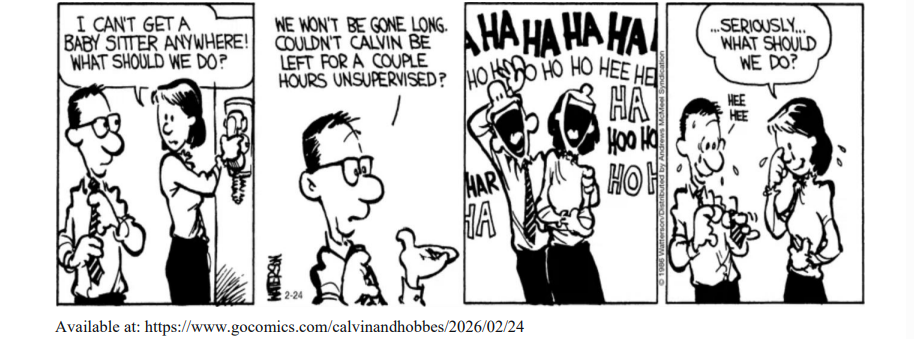
After the father asks, “Couldn’t Calvin be left for a couple hours unsupervised?”, the parents immediately burst into laughter. This reaction suggests that:

😭 Você errou!   Resposta: 😘 Parabéns! Você acertou!

Escolha quais comentários gostaria de ver

Carregando comentários dos alunos...
Carregando marcador...

MIA

Entenda a questão e transforme a dificuldade em um próximo passo de estudo.

Como a MIA pode ajudar?

🔒 Tire sua dúvidaDisponível nos planos pagos.
🔒 Plano de revisãoDisponível nos planos pagos.

A teacher in the final years of lower secondary education organizes lessons around real-life situations. Students work in small groups to investigate a problem, collect information, discuss possible solutions, and present their findings to the class. The teacher acts mainly as a facilitator, guiding the process rather than delivering long explanations. 

This description best represents which teaching approach?

😭 Você errou!   Resposta: 😘 Parabéns! Você acertou!

Escolha quais comentários gostaria de ver

Carregando comentários dos alunos...
Carregando marcador...

MIA

Entenda a questão e transforme a dificuldade em um próximo passo de estudo.

Como a MIA pode ajudar?

🔒 Tire sua dúvidaDisponível nos planos pagos.
🔒 Plano de revisãoDisponível nos planos pagos.
Texto associado
Last week at my neighborhood coffee shop, the barista flipped that dreaded tablet toward me. Three tip options glared back: 18%. 22%. 25%. For a $3.50 latte I was picking up. That took thirty seconds to make. I’ve hit my breaking point with tipping culture. 
Growing up, tipping was simple: 15–20% for sitdown restaurants, maybe your hairdresser. Now it’s an expected tax on every transaction. The frozen yogurt shop where I serve myself wants 20%. Self-checkout kiosks are asking for tips. This is insane. 
When I traveled Europe last summer, I paid exactly what was on the menu. No guilt, no calculations, no awkward pressure. Servers were paid living wages and the service was excellent. 
Meanwhile, I’m expected to subsidize corporate America’s refusal to pay fair wages while their CEOs pocket millions in bonuses. It’s 2025, and American tipping culture has spiraled out of control. It’s hurting workers, stressing customers, and letting profitable businesses guilt-trip their own customers into covering payroll. When I worked retail years ago, my employer paid my full wage. I didn’t expect customers to subsidize my paycheck because my boss decided to pocket the difference. Yet somehow in 2025, we’ve normalized corporations outsourcing their payroll responsibility to guilt-ridden customers. 72% of U.S. adults say tipping is expected in more places today than it was five years ago. But even as Americans say they’re being asked to tip more often, only about a third say it’s extremely or very easy to know whether (34%) or how much (33%) to tip for various services. 
[...] The confusion is real and it’s intentional. Companies benefit from our uncertainty because confused customers tend to over-tip rather than risk social judgment. 

Based on the text, how does the author's experience in Europe contrast with his experience in America?

😭 Você errou!   Resposta: 😘 Parabéns! Você acertou!

Escolha quais comentários gostaria de ver

Carregando comentários dos alunos...
Carregando marcador...

MIA

Entenda a questão e transforme a dificuldade em um próximo passo de estudo.

Como a MIA pode ajudar?

🔒 Tire sua dúvidaDisponível nos planos pagos.
🔒 Plano de revisãoDisponível nos planos pagos.
Texto associado
Last week at my neighborhood coffee shop, the barista flipped that dreaded tablet toward me. Three tip options glared back: 18%. 22%. 25%. For a $3.50 latte I was picking up. That took thirty seconds to make. I’ve hit my breaking point with tipping culture. 
Growing up, tipping was simple: 15–20% for sitdown restaurants, maybe your hairdresser. Now it’s an expected tax on every transaction. The frozen yogurt shop where I serve myself wants 20%. Self-checkout kiosks are asking for tips. This is insane. 
When I traveled Europe last summer, I paid exactly what was on the menu. No guilt, no calculations, no awkward pressure. Servers were paid living wages and the service was excellent. 
Meanwhile, I’m expected to subsidize corporate America’s refusal to pay fair wages while their CEOs pocket millions in bonuses. It’s 2025, and American tipping culture has spiraled out of control. It’s hurting workers, stressing customers, and letting profitable businesses guilt-trip their own customers into covering payroll. When I worked retail years ago, my employer paid my full wage. I didn’t expect customers to subsidize my paycheck because my boss decided to pocket the difference. Yet somehow in 2025, we’ve normalized corporations outsourcing their payroll responsibility to guilt-ridden customers. 72% of U.S. adults say tipping is expected in more places today than it was five years ago. But even as Americans say they’re being asked to tip more often, only about a third say it’s extremely or very easy to know whether (34%) or how much (33%) to tip for various services. 
[...] The confusion is real and it’s intentional. Companies benefit from our uncertainty because confused customers tend to over-tip rather than risk social judgment. 

In the sentence “I’ve hit my breaking point with tipping culture.”, the expression “hit my breaking point” is closest in meaning to:

😭 Você errou!   Resposta: 😘 Parabéns! Você acertou!

Escolha quais comentários gostaria de ver

Carregando comentários dos alunos...
Carregando marcador...

MIA

Entenda a questão e transforme a dificuldade em um próximo passo de estudo.

Como a MIA pode ajudar?

🔒 Tire sua dúvidaDisponível nos planos pagos.
🔒 Plano de revisãoDisponível nos planos pagos.